Exactly as the exam asked them. Choose an option: you will see at once if it is right, and the small facts behind the question.
Take your time. Answer, see why, and reattempt any question as often as you like.
10 questions · 7 minutes · 40 seconds a question. Once you move on, you can’t come back, and answers show only at the end. Just like the real hall.
Whole test0:00
This question40
#13 · NTA UGC-NET/JRF · 5th Jan. 2022 shif-2
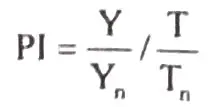
Who among the following scholars applied the formula
where PI = Agricultural productivity index; Y = Total production of selected crops in unit area; Y, Total production of the same selected crops in the country; T = Total cropped area of the unit; Tn = Total cropped area in the country for measuring agricultural productivity level.
Show answer
Answer: option (4): Shafi
Explanation
How is agricultural productivity measured?
By output per unit area against the regional average: M. G. Kendall's ranking coefficient (1939), Stamp's carrying capacity, Enyedi's index (1964), Mohammad Shafi's productivity index, and S. S. Bhatia's efficiency index (Uttar Pradesh, 1967).
Why is this the answer?
PI = (Y/Yn) ÷ (T/Tn) compares a unit's production share with its area share against the nation. The key credits Shafi (1960s) with this form.
What about each option?
Bhatia weighted yield indices by area.
Enyedi used a different yield-share index.
Weaver did crop combination.
Right: Shafi.
How do I remember it?
💡 In the formula, n means the national total.
#14 · NTA UGC-NET/JRF · Dec.2020
The characteristics of the countries engaged in subsistence farming include
(1) (A),(B)and (D) only
(2) (B),(C) and (D) only
(3) (B) and (C) only
(4) (B),(D) and (C) only
Show answer
Answer: option (4): High developed international trade
Explanation
What is intensive subsistence farming?
Small, crowded holdings worked hard by hand to feed the family, mainly rice in the monsoon lands of South, South-East and East Asia; little land is left for animals.
What marks an underdeveloped economy?
Most people work in farming, incomes and savings are low, technology is simple, population grows fast, and the country exports raw materials.
Why is this the answer?
In this question the options are mixed up with the statements. Subsistence countries have a developing economy, dense population and low technology. Highly developed international trade does not fit. Keyed: option (4), 'B, D and C', as printed.
What about each option?
This trait (developing economy) does fit.
This trait (dense population) does fit.
This trait (low technology) does fit.
Right: as keyed. Note that 'high international trade' does not fit subsistence farming.
How do I remember it?
💡 Subsistence means produce is eaten, not sold.
#16 · NTA UGC-NET/JRF · Dec.2020
Consider the following statements regarding the weaver's method of crop combination.
(1) (A),(B)and (C) only
(2) (A),(C) and (D) only
(3) (A) and (B) only
(4) (A) and (C) only
Show answer
Answer: option (4): He adopted a measure of yied defined as the potential production of one acre of good average farmland under good management
Explanation
What is crop combination analysis?
A way to find which group of crops dominates an area. J. C. Weaver (1954, US Middle West) used the minimum deviation method; K. Doi (1959) and D. Thomas (1963) modified it; Rafiullah gave the maximum positive deviation method.
Why is this the answer?
In this question the options are mixed up with the statements. Weaver (1954) offered a method better than simple inspection (A) and minimised the gap between actual and theoretical combinations (C). B and D describe Coppock and Stamp (British land), not Weaver. Keyed: 'A and C only'.
What about each option?
This statement (A) is true for Weaver.
This statement (B) is about Britain, not Weaver.
This statement (C) is true for Weaver.
Right: as keyed, A and C only.
How do I remember it?
💡 Weaver's data came from the US Middle West in 1954.
#17 · NTA UGC-NET/JRF · Dec.2020
Assertion (A) :Von Thunen argued that the sectoral fields are the most irrational, reducing the spent by the farmers in travelling around the farm.
Reason (R) : Sectoral fields are not common but they are used in varying farming system and environment.
Show answer
Answer: option (4): (A) is not correct but (R) is correct
Explanation
What is von Thünen's model?
J. H. von Thünen's Isolated State (1826) put one city in a flat, even plain; farm uses form rings round it by how much rent each earns after transport cost: market gardening and dairy, forestry, intensive crop rotation, rotation with pasture, the three-field system, ranching, then waste.
What are the main farming types?
Subsistence and commercial farming; mixed farming joins crops with livestock; plantation, dairy, market gardening and extensive grain farming are others.
Why is this the answer?
Thünen's work did not call sector-shaped fields the most irrational, so A is wrong as written. R is a fair general observation, since sector fields do occur in some systems.
What about each option?
Both true and R explains A.
Both true, but R does not explain A.
A true, R false.
Right: A false, R true.
How do I remember it?
💡 Check A and R separately first, then ask: does R answer 'why A?'
#18 · NTA UGC-NET/JRF · Dec.2020
Assertion (A) :In areas of intensive subsistence agriculture, animal husbandry is meager sideline of crop farming.
Reason (R) : Throughout the region, the farmers are handicapped in raising cattle due to lake of scientific methods of breeding the animals.
Show answer
Answer: option (2): Both (A) and (R) are true, (R) is NOT correct explanation of (A)
Explanation
What is intensive subsistence farming?
Small, crowded holdings worked hard by hand to feed the family, mainly rice in the monsoon lands of South, South-East and East Asia; little land is left for animals.
Who are the big names of agricultural geography?
G. G. Chisholm's Handbook of Commercial Geography (1889), Leslie Symons's Agricultural Geography (1967), Eduard Hahn on hoe farming, and Indian scholars Jasbir Singh, Mohammad Shafi and S. S. Bhatia.
Why is this the answer?
In rice-based Asia, animals are a sideline (A true). Poor breeding is real (R true), but the main reason is that land is too scarce for fodder, so R does not explain A.
What about each option?
Both true and R explains A.
Right: Both true, but R does not explain A.
A true, R false.
A false, R true.
How do I remember it?
💡 Check A and R separately first, then ask: does R answer 'why A?'
#19 · NTA UGC-NET/JRF · Dec.2019
Which one of the following characteristics is best suited to intensive farming ?
Show answer
Answer: option (3): High yield rate
Explanation
What is intensive subsistence farming?
Small, crowded holdings worked hard by hand to feed the family, mainly rice in the monsoon lands of South, South-East and East Asia; little land is left for animals.
What are the main farming types?
Subsistence and commercial farming; mixed farming joins crops with livestock; plantation, dairy, market gardening and extensive grain farming are others.
Why is this the answer?
Intensive farming puts heavy labour and capital into small plots to get a high yield per hectare.
What about each option?
Large farms go with extensive farming.
Low labour goes with extensive farming.
Right: High yield rate.
Sparse population goes with extensive farming.
How do I remember it?
💡 Intensive = high input and high output per hectare.
#20 · NTA UGC-NET/JRF · Dec.2019
Arrange the following methods of delineating crop combination regions in order of their apperrance :
(a) Doi's method
(b) Rafiullah's method
(c) Weaver's method
(d) Coppock's method
Show answer
Answer: option (3): (c), (b), (a), (d)
Explanation
What is crop combination analysis?
A way to find which group of crops dominates an area. J. C. Weaver (1954, US Middle West) used the minimum deviation method; K. Doi (1959) and D. Thomas (1963) modified it; Rafiullah gave the maximum positive deviation method.
Why is this the answer?
In order of appearance: Weaver (1954), Doi (1959), Coppock (1964), Rafiullah (1965). No printed option matches this exactly. The key (3), 'c, b, a, d', puts Weaver first, which is the main point tested.
What about each option?
Starts with Doi, but Weaver came first.
Starts with Rafiullah.
Right: as keyed. Weaver first is the key fact.
Starts with Coppock.
How do I remember it?
💡 Weaver 1954, then Doi 1959, then Coppock 1964, then Rafiullah 1965.
#21 · NTA UGC-NET/JRF · June.2019
The proportion of area under various crops at a point of time is known as :
Show answer
Answer: option (2): cropping pattern
Explanation
What is crop combination analysis?
A way to find which group of crops dominates an area. J. C. Weaver (1954, US Middle West) used the minimum deviation method; K. Doi (1959) and D. Thomas (1963) modified it; Rafiullah gave the maximum positive deviation method.
Why is this the answer?
The share of area under each crop at a given time is the cropping pattern.
What about each option?
Combination means the leading crops grouped together.
Right: Cropping pattern.
Concentration means one crop's density.
Diversification means the spread of many crops.
How do I remember it?
💡 Pattern = a snapshot of area shares.
#23 · NTA UGC-NET/JRF · June.2019
D. Whittlessey divided the whole world into how many types of agriculture regions?
Show answer
Answer: option (2): 13
Explanation
How did Whittlesey classify agriculture?
Derwent Whittlesey (1936) divided the world into 13 agricultural regions using five criteria: crop and livestock combination, intensity of land use, processing and marketing of produce, degree of mechanization, and the types and association of farm buildings.
Why is this the answer?
Whittlesey (1936) identified 13 agricultural regions of the world.
What about each option?
Too few.
Right: 13.
Too many.
Too many (repeated option).
How do I remember it?
💡 5 criteria, 13 regions.
#24 · NTA UGC-NET/JRF · Dec.2018
Identify the correct sequence of vegetation belts at different altitudes in the equatorial mountains of East Africa in descending order (top of bottom).
How do vegetation belts change with height near the equator?
From rain forest at the foot (tierra caliente) to montane forest (tierra templada), cloud forest and grassland (tierra fría), up to alpine meadows and snow (tierra helada).
How much forest does the world have?
About 4.06 billion hectares in 2020, roughly 31% of the land; Russia has the most, then Brazil, Canada, the USA and China.
Why is this the answer?
From top to bottom on the East African peaks (Kilimanjaro, Mount Kenya): Afro-alpine moorland, then the Ericaceous heath belt, then bamboo, then lowland or montane forest.
What about each option?
This is the bottom-up order.
Right: Afro-alpine, Ericaceous, Bamboo, Lowland.
Bamboo and forest are swapped.
Jumbled.
How do I remember it?
💡 Giant groundsels and lobelias grow in the Afro-alpine belt.
Question source: NTA UGC-NET/JRF and state Assistant Professor exam papers. The flip cards and notes here are written afresh.