Exactly as the exam asked them. Choose an option: you will see at once if it is right, and the small facts behind the question.
Take your time. Answer, see why, and reattempt any question as often as you like.
10 questions · 7 minutes · 40 seconds a question. Once you move on, you can’t come back, and answers show only at the end. Just like the real hall.
Whole test0:00
This question40
#2 · NTA UGC-NET/JRF · March 2023 slot -1
Identify the main product of truck farming and factory farming, respectively ?
Show answer
Answer: option (3): Vegetables and Poultry.
Solution
Why is this the answer?
Truck farming grows vegetables for distant city markets. Factory farming rears poultry and livestock indoors on industrial lines.
What about each option?
Timber is forestry.
Corn is a field crop.
Right: Vegetables and poultry.
Both belong to horticulture.
How do I remember it?
💡 Factory farming = broilers and eggs in sheds.
#3 · NTA UGC-NET/JRF · March 2023 slot -1
Which of the following statements are NOT correct with reference to Von Thunen’s Agricultural Location Theory ?
(E) Isotrophic surface are universal in Asia.
Choose the most appropriate answer from the options given below :
(1) A, C and E Only
(2) A, B and C Only
(3) C, D and E Only
(4) A, B, C and E Only
Show answer
Answer: option (4): Firewood and timber production zone has lose its validity.
Solution
Why is this the answer?
This question is garbled in the source: the statements A–D were printed as options. The NOT-correct statements are: Thünen's rent was his own idea (Ricardo, not Weaver); he did discuss a navigable river distorting the rings; real farmers are not always rational; and isotropic surfaces are not universal anywhere. Keyed: option (4), 'A, B, C and E'.
What about each option?
Statement A is wrong: the rent idea came from Thünen and Ricardo, not Weaver.
Statement B is wrong: Thünen himself showed a river stretching the zones.
Statement C is wrong: farmers satisfice (Wolpert).
Right: as keyed, A, B, C and E are not correct.
How do I remember it?
💡 The firewood ring losing its validity (D) is a true modern criticism.
#4 · NTA UGC-NET/JRF · March 2023 slot -2
Match List I with List II:
List I (Work)
List II (Scholar)
(A)
Crop-combination analysis
(I)
Stouffer
(B)
Isolated state
(II)
Whittlesey, D
(C)
Intervening opportunities
(III)
Von Thunen
(D)
Sequent Occupance
(IV)
Weaver, J.C.
Choose the correct answer from the options given below:
Weaver gave crop combination (IV). Von Thünen wrote 'The Isolated State' (III). Stouffer gave intervening opportunities (I, 1940). Whittlesey gave sequent occupance (II, 1929).
What about each option?
Swaps Stouffer and Whittlesey.
Wrong for A.
Wrong for A.
Right: IV, III, I, II.
How do I remember it?
💡 Sequent occupance means successive human imprints on one place.
#5 · NTA UGC-NET/JRF · March 2023 slot -2
Identify the correct sequence of the concentric zones of different land uses from the city center in Von Thunen's model?
A. Crop farming without fallow
B. Firewood and timber
C. Market gardening and milk production
D. Three-field system
E. Livestock ranching
Choose the correct answer from the options given below:
Show answer
Answer: option (3): C, B, A, D, E
Solution
Why is this the answer?
From the town outward: market gardening and milk (C), firewood (B), crop farming without fallow (A), the three-field system (D), then ranching (E).
What about each option?
Firewood is not first.
Firewood is not third.
Right: C, B, A, D, E.
Ranching is not third.
How do I remember it?
💡 Perishable and heavy goods come first; extensive uses go last.
#6 · NTA UGC-NET/JRF · Dec., 2023
Which one of the following is NOT among the five criteria adopted by Whittelesey in classification of world agriculture types?
A. Crop and livestock Combination
B. Methods and techniques used to grow crops and raise livestock
C. Disposal of agriculture products or livestock
D.Level of agriculture productivity
Show answer
Answer: option (4)
Solution
Why is this the answer?
Whittlesey's five criteria are: crop and livestock combination, intensity, disposal of produce, methods, and buildings. Productivity level is not one of them.
What about each option?
Is a criterion.
Is a criterion.
Is a criterion.
Right: Productivity level.
How do I remember it?
💡 5 criteria, 13 regions, 1936.
#7 · NTA UGC-NET/JRF · Dec., 2023
Which of the following is practiced in North American Plains?
Show answer
Answer: option (2): Commercial Grain Farming
Solution
Why is this the answer?
The Prairies and Great Plains of the USA and Canada grow wheat and corn on large mechanised farms. That is commercial grain farming.
What about each option?
Dairy belongs to the Great Lakes and New England.
Right: Commercial grain farming.
Horticulture belongs to California and Florida.
Rice-dominant subsistence belongs to Monsoon Asia.
How do I remember it?
💡 Other grain lands: Pampas, Ukraine steppe, Murray-Darling.
#8 · NTA UGC-NET/JRF · Dec., 2023
_________modified Von Thunen's model of Land use in 1925.
Show answer
Answer: option (1): Jonasson
Solution
Why is this the answer?
Olof Jonasson (1925) extended von Thünen's rings to Europe and the world around the North Atlantic urban market.
What about each option?
Right: Jonasson.
Valkenburg (1952) mapped world agricultural intensity.
💡 Horvath found a real 'firewood ring' in Ethiopia.
#9 · NTA UGC-NET/JRF · Oct., 2022
Assertion (A): Any lack of water to satisfy the normal needs of agriculture. livestock. industry or human population may be termed as a drought
Reasons (R): Drought is a distress situation caused by lack of rainfall
Show answer
Answer: option (1): Both (A) and (R) are true and (R) is correc explanation of (A)
Solution
Why is this the answer?
A gives the broad definition of drought (any water shortfall). R gives its root cause, a lack of rainfall. Both are true and R explains A.
What about each option?
Right: Both true and R explains A.
Both true, but R does not explain A.
A true, R false.
A false, R true.
How do I remember it?
💡 Types of drought: meteorological, hydrological, agricultural, socio-economic.
#10 · NTA UGC-NET/JRF · Oct., 2022
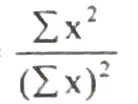
Crop Diversification Index =
In the above formula, ‘x’ refers to :
Show answer
Answer: option (2): Total cropped area occupied by each crop
Solution
Why is this the answer?
Bhatia's diversification index = (% of total cropped area under the x crops) ÷ (number of x crops). Here x is the area occupied by each crop counted.
What about each option?
GCA is the base, not x.
Right: The area occupied by each crop.
NSA is not used.
NSA is not used.
How do I remember it?
💡 A higher index means more diversification.
#11 · NTA UGC-NET/JRF · Oct., 2022
Statement I: Shafi calculated agricultural productivity through ranking co-efficient method in the year 1990.
Statemet II: Agricultural productivity as an input-output ratio was calculated by Khusro in the year 1964.
Show answer
Answer: option (4): Statement I is false but Statement II is true
Solution
Why is this the answer?
Kendall (1939) devised the ranking coefficient; Shafi worked on productivity in the 1960s–80s, so 'Shafi, ranking coefficient, 1990' is wrong. Khusro (1964) measured productivity as an input-output ratio, which is true.
What about each option?
Both statements true.
Both statements false.
I true, II false.
Right: I false, II true.
How do I remember it?
💡 Test each statement alone; one wrong year or name makes it false.
Question source: NTA UGC-NET/JRF and state Assistant Professor exam papers. The flip cards and notes here are written afresh.