Exactly as the exam asked them. Choose an option: you will see at once if it is right, and the small facts behind the question.
Take your time. Answer, see why, and reattempt any question as often as you like.
10 questions · 7 minutes · 40 seconds a question. Once you move on, you can’t come back, and answers show only at the end. Just like the real hall.
Whole test0:00
This question40
#72 · NTA UGC-NET/JRF · July.2016
In which year, M. Jefferson examined the size relation between the preimate city and next largsest cities in a study entitled "The Law of the Primate City'?
Show answer
Answer: option (4): 1939
Solution
Why is this the answer?
Jefferson's The Law of the Primate City was published in 1939.
What about each option?
Too early
Too early
Too early
Right: 1939
How do I remember it?
💡 1939: primate city.
#73 · NTA UGC-NET/JRF · July.2016
Which one of the following contributors made refinem,ents to W.Christaller's central place by including concept of 'city rich'sector and 'city poor' sectors
A. R.P. Mishra
B. B.J.L.Berry
B. Walter Isard
D. August Losch
Show answer
Answer: option (4)
Solution
Why is this the answer?
August Lösch refined Christaller by rotating the hexagonal nets so that centres line up into city-rich and city-poor sectors around a metropolis.
What about each option?
Indian regional planner
Worked on city systems
Regional science
Right: August Lösch
How do I remember it?
💡 Lösch's wheel: rich spokes and poor gaps.
#75 · NTA UGC-NET/JRF · Dec 2015
Which one of the following cities is known as the 'Mile City' ?
Show answer
Answer: option (3): Denver
Solution
Why is this the answer?
Denver is the Mile High City, exactly one mile (5,280 ft) above sea level.
What about each option?
The Emerald City
The Valley of the Sun
Right: Denver
Not called this
How do I remember it?
💡 Denver: one mile up.
#76 · NTA UGC-NET/JRF · Dec.2015
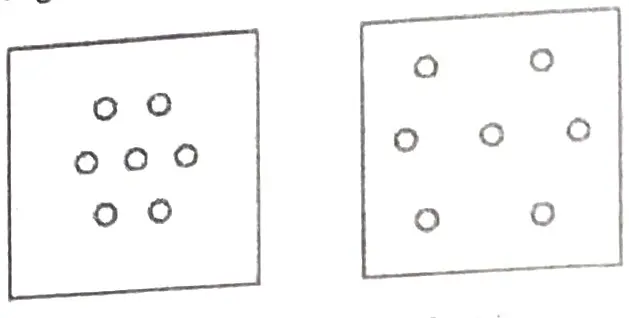
Which one of the following codes is correct to explain the base of given distribution of settelments of an area?
Show answer
Answer: option (2): Spacing
Solution
Why is this the answer?
The figure in the original shows settlements spread over an area; their pattern is read from the spacing between them.
What about each option?
Counts how many, not the pattern
Right: spacing
Not a measure of distribution
About each settlement, not the pattern
How do I remember it?
💡 Pattern = how far apart.
#77 · NTA UGC-NET/JRF · Dec.2015
Which one of the following does not refer to 'Primate City'?
Show answer
Answer: option (2): Rabat
Solution
Why is this the answer?
Harare, Windhoek and Gaborone dominate their countries, but Rabat is smaller than Casablanca, so it is not Morocco's primate city.
What about each option?
Primate city of Zimbabwe
Right: Casablanca, not Rabat, is the largest
Primate city of Namibia
Primate city of Botswana
How do I remember it?
💡 Morocco: capital Rabat, giant Casablanca.
#78 · NTA UGC-NET/JRF · Dec.2015
Which one of the concept discribes the absence of cities and towns within a radius of 75 km from large city?
Show answer
Answer: option (4): Urban Shadows
Solution
Why is this the answer?
A big city draws trade and people from its surroundings so strongly that no sizeable town grows nearby. That empty ring is called the urban shadow.
What about each option?
A group of towns, the opposite
Spreading out, not absence
Merged towns, the opposite
Right: urban shadow
How do I remember it?
💡 Tall tree, no saplings in its shade.
#79 · NTA UGC-NET/JRF · Dec.2015
The 'Triangular Pattern' of Rural Settelment develop generally?
Show answer
Answer: option (2): at the confluence of two rivers
Solution
Why is this the answer?
A triangular village grows in the wedge of land at the confluence of two rivers, bounded by both banks.
What about each option?
That gives a linear pattern
Right: at the confluence of two rivers
That gives a linear or gap pattern
Not the standard description
How do I remember it?
💡 Two rivers meet, the village fills the triangle.
#80 · NTA UGC-NET/JRF · Dec.2015
Which one of the following authors examined the stucture of urban settelment prior to the impact of large-scale industrialisation in book 'The Pre-Industrial City Past and Present'?
Show answer
Answer: option (2): G. Sjoberg
Solution
Why is this the answer?
Gideon Sjoberg wrote The Preindustrial City: Past and Present (1960), describing cities before industrialisation, with the elite at the centre and the poor at the edge.
What about each option?
Pacione wrote Urban Geography
Right: Sjoberg
Hall wrote on world cities
Dwyer wrote on Third World cities
How do I remember it?
💡 Sjoberg: in old cities the rich lived in the middle.
#81 · NTA UGC-NET/JRF · Dec.2015
Which one of the following author's theory of primate cities focuses on the forces of agglomeration and cumulative effects of agglomeration in the growth of large cities?
Show answer
Answer: option (4): Mark Jefferson
Solution
Why is this the answer?
Jefferson argued that once a city gets ahead, agglomeration and cumulative advantage make it grow ever larger, producing a primate city.
What about each option?
Central places, not primacy
Rank-size, not primacy
Not the author
Right: Mark Jefferson
How do I remember it?
💡 The leader keeps leading: cumulative growth.
#83 · NTA UGC-NET/JRF · Dec.2015
Match List -I with List-II
List-I
List-II
I
Slum Zone
A
Lack in prestige and characterised by low grade retail stores, warehouses and wholesale trading premises and a high proportion of vacant property
II
Zone of Assimilation
B
Extensive areas of low density housing
III
Suburban
C
Extensive redevelopment Zone and spread of shopes, offices and hotels into former residential areas
IV
Zone of density
D
Residential belt of considerable Discard surrounding the C.B.D
Select the correct answer from the codes given below:
(a)
(b)
(c)
(d)
A.
(iv)
(iii)
(ii)
(i)
B.
(ii)
(i)
(iv)
(iii)
C.
(i)
(iv)
(iii)
(ii)
D.
(iii)
(ii)
(i)
(iv)
Show answer
Answer: option (1)
Solution
Why is this the answer?
The slum zone is the residential belt around the CBD (D, iv); the zone of assimilation is where shops and offices spread into old housing (C, iii); suburbs have low-density housing (B, ii); the zone of discard has low-grade stores and vacant property (A, i). Code A: iv, iii, ii, i. ("Zone of density" is a misprint for zone of discard.)
What about each option?
Right: iv, iii, ii, i
Wrong order
Wrong order
Wrong order
How do I remember it?
💡 The CBD gains on the assimilation side, loses on the discard side.
Question source: NTA UGC-NET/JRF and state Assistant Professor exam papers. The flip cards and notes here are written afresh.