Exactly as the exam asked them. Choose an option: you will see at once if it is right, and the small facts behind the question.
Take your time. Answer, see why, and reattempt any question as often as you like.
10 questions · 7 minutes · 40 seconds a question. Once you move on, you can’t come back, and answers show only at the end. Just like the real hall.
Whole test0:00
This question40
#86 · NTA UGC-NET/JRF · June2015
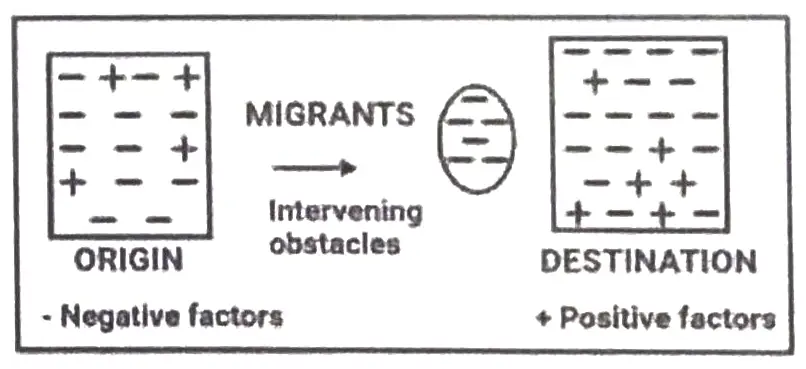
Which one of the following is the propounded of the shown model?
Show answer
Answer: option (4): Lee's Model of Migration
Solution
Why is this the answer?
The figure in the original shows origin and destination with plus and minus factors and intervening obstacles between them. That is Everett Lee's model of migration (1966). See the "see original" view.
What about each option?
Zelinsky shows stages over time
Not this diagram
Gosal worked on Indian population, not this model
Right: Lee's model
How do I remember it?
💡 Lee: pluses, minuses and a hurdle in the middle.
#88 · NTA UGC-NET/JRF · Dec. 2014
Assertion (A) : Amazon basin has very low density of population .
Reason (R) : The Amazon basin is endowed with hot and humid climate that led to luxuriant selvas.
Show answer
Answer: option (1): Both (A) and (R) are correct and (R) is correct explanation of (A)
Solution
Why is this the answer?
The Amazon is thinly peopled, and the reason is its hot, humid climate and dense rainforest (selva), which make farming, travel and health hard.
What about each option?
Right: both true, R explains A
R does explain A
R is also true
A is also true
How do I remember it?
💡 Thick selva, thin people.
#89 · NTA UGC-NET/JRF · June.2014
Net population change is determined by
Show answer
Answer: option (4): Both (A) and (C)
Solution
Why is this the answer?
The key picks fertility and mortality, the two parts of natural change. Strictly, a region's net change also includes migration; for the world as a whole, migration cancels out.
What about each option?
Only one part
A part for regions, but not keyed
Only one part
Right: fertility and mortality, as keyed
How do I remember it?
💡 Births minus deaths = natural change.
#90 · NTA UGC-NET/JRF · June.2014
Which of the following conditions is characterised by the second stage of Demographic Transition ?
Show answer
Answer: option (3): High birth rate, declining death rate
Solution
Why is this the answer?
Stage 2 keeps a high birth rate while the death rate falls, so population grows fast.
What about each option?
Does not occur as a stage
Stage 1
Right: high births, falling deaths
Stage 4
How do I remember it?
💡 Stage 2 = boom.
#92 · NTA UGC-NET/JRF · June.2014
‘Chain migration’ is based on :
Show answer
Answer: option (2): Kinship
Solution
Why is this the answer?
In chain migration, earlier migrants help relatives and friends from the same village follow them. It runs on kinship networks.
What about each option?
A cause of migration in general
Right: kinship
Not the basis of the chain
Not keyed
How do I remember it?
💡 One cousin moves, the whole family follows.
#93 · NTA UGC-NET/JRF · Dec.2013
Demographic transition framework that explore the historical sequence of changes in
1. Fertility and migration
2. Mortality and age-structure
3. Mortality and migration
4. Age-structure and sex composition
Codes:
Show answer
Answer: option (4): 1 and 2 are correct.
Solution
Why is this the answer?
Transition theory traces the historical change in fertility and in mortality, and with them the change in age structure. The key accepts statements 1 and 2.
What about each option?
Sex composition is not its core
Migration is not its core
Leaves out mortality
Right: 1 and 2
How do I remember it?
💡 Births, deaths and the ages they leave behind.
#94 · NTA UGC-NET/JRF · Dec.2013
Migration from developed to less developed region is called as
Show answer
Answer: option (3): Perverse migration
Solution
Why is this the answer?
Movement from a developed region to a less developed one goes against the usual flow, so it is called perverse migration.
What about each option?
Leaving a country, any direction
Entering a country, any direction
Right: perverse migration
Going back to one's origin
How do I remember it?
💡 Perverse = against the stream.
#95 · NTA UGC-NET/JRF · Dec.2013
Assertion (A): Physical factors provide only a partial and deterministic explanation of geographical distribution of population
Reason (R): Man is by no means passive in his choice of areas for settlement and every where demonstrates an ability to exercise some control over his environment.
Show answer
Answer: option (2): Both(A)and (R)are correct but(R)is NOT correct explanation of A
Solution
Why is this the answer?
Both are true. Physical factors explain only part of where people live, and humans do shape their environment. But the key says R is not the explanation of A: A is about the limits of physical explanation, R about human agency in general.
What about each option?
The key does not accept R as the explanation
Right: both true, R not the explanation
R is also true
A is also true
How do I remember it?
💡 Nature sets the stage, people write the play.
#96 · NTA UGC-NET/JRF · Dec.2013
Which one of the following stages of demographic transition model predicts "a-high birth but a-low death rate"?
Show answer
Answer: option (2): Second stage
Solution
Why is this the answer?
The second stage has a high birth rate and a low (falling) death rate.
What about each option?
Both rates high
Right: second stage
Birth rate falls here
Not a separate stage name
How do I remember it?
💡 Stage 2 = births high, deaths down.
#97 · NTA UGC-NET/JRF · June.2013
In developing countries, the population pressure increases in some parts due to immigration. Such parts are characterized by
Show answer
Answer: option (3): Large employment opportunities
Solution
Why is this the answer?
People move into parts of developing countries that offer many jobs, such as big cities and industrial belts. That inflow raises population pressure there.
What about each option?
Cities are usually costlier
Climate is a minor pull
Right: large employment opportunities
Helps, but jobs are the main pull
How do I remember it?
💡 Migrants follow work.
Question source: NTA UGC-NET/JRF and state Assistant Professor exam papers. The flip cards and notes here are written afresh.