Exactly as the exam asked them. Choose an option: you will see at once if it is right, and the small facts behind the question.
Take your time. Answer, see why, and reattempt any question as often as you like.
10 questions · 7 minutes · 40 seconds a question. Once you move on, you can’t come back, and answers show only at the end. Just like the real hall.
Whole test0:00
This question40
#34 · NTA UGC-NET/JRF · Dec 2018
Which one of the following indices is used to indicate if the optimal location was closer to either raw material source or the market ?
Show answer
Answer: option (1): Material Index
Solution
Why is this the answer?
Weber's material index (localised material weight ÷ product weight) shows whether the source or the market pulls.
What about each option?
Right: Material index.
Not Weber's term.
The labour cost index is about labour pull.
Not Weber's term.
How do I remember it?
💡 MI > 1 source; MI < 1 market.
#35 · NTA UGC-NET/JRF · July.2018
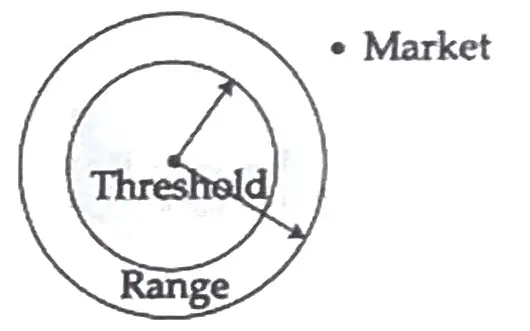
Which one of the following modals is explained by the given figure below :
Show answer
Answer: option (2): Central Place Models
Solution
Why is this the answer?
This is a diagram question, and the picture is in the 'see original' view. It shows hexagonal market areas, which are typical of central place models.
What about each option?
Weber uses a triangle.
Right: central place (hexagons).
Thünen uses rings.
The gravity model uses flows.
How do I remember it?
💡 Hexagons = Christaller and Lösch.
#36 · NTA UGC-NET/JRF · July.2018
Among the following scholars, who introduced the concept of 'least-transport-cost location' using the frame of 'Location traingle'.
(1) W.Isard
(2) M.K.Badnam
(2) D.M.Smith
(4) A.Weber
Show answer
Answer: option (4)
Solution
Why is this the answer?
Alfred Weber (1909) used a locational triangle (two raw material sources and a market) to find the least-transport-cost point.
What about each option?
Isard used substitution analysis.
Bandman worked on territorial production complexes.
Smith gave spatial margins.
Right: Alfred Weber.
How do I remember it?
💡 Varignon's frame is the mechanical model of this triangle.
#37 · NTA UGC-NET/JRF · July.2018
Which one of the following conditions Alfred Weber introduced in his concepts of 'Locational Triangle'?
(where: 'R1' and 'R2' are two raw materials)
Show answer
Answer: option (4): Both 'R1' and 'R2' are fixed and gross
Solution
Why is this the answer?
In the triangle, both materials are localised (fixed) and gross (weight-losing). Only then do they pull the plant away from the market.
What about each option?
Ubiquitous materials pull to the market.
Garbled option.
Pure materials do not pull.
Right: Fixed and gross.
How do I remember it?
💡 Gross materials lose weight; pure ones do not.
#38 · NTA UGC-NET/JRF · Nov.2017
Transportation Cost does not play a major role in the location of textile industry because:
Show answer
Answer: option (3): Cotton is a pure material morte or less equal to the finished material
Solution
Why is this the answer?
Cotton is a pure material: yarn weighs about the same as the raw cotton. With no weight saved by moving to the source, mills are freer to locate.
What about each option?
No, it is not weight-losing.
No.
Right: Pure material.
No.
How do I remember it?
💡 Mumbai and Ahmedabad mills grew near markets and ports.
#39 · NTA UGC-NET/JRF · Nov.2017
Which activity contributes to water pollution more than any other throughout the world ?
Show answer
Answer: option (3): Mnufacturing industries
Solution
Why is this the answer?
The key says manufacturing industry is the biggest polluter (effluents, heavy metals). Note that the FAO and UNEP now often name agriculture (nutrient runoff) as the largest source by volume.
What about each option?
Agriculture is a big rival answer in newer reports.
Hydro power pollutes little.
Right: Manufacturing industries.
Urban sewage is large, but not keyed.
How do I remember it?
💡 Know both answers: older texts say industry, newer FAO reports say agriculture.
#40 · NTA UGC-NET/JRF · Nov.2017
Which one of the following ocean routs is the most imporatnt and busiest route in the world ?
Show answer
Answer: option (4): North Atlantic Route
Solution
Why is this the answer?
The North Atlantic route links the two great industrial regions, North-east USA and Western Europe. It carries about a quarter of world trade and is called the 'Big Trunk Route'.
What about each option?
The Cape route goes round South Africa.
The North Pacific route is growing, but second.
The South Atlantic route is minor.
Right: The North Atlantic route.
How do I remember it?
💡 North Atlantic = Big Trunk Route.
#41 · NTA UGC-NET/JRF · Nov.2017
Which one of the following was not assured by Weber in his least-cost theory
Show answer
Answer: option (1): Agglomeration economics lead to high transport and labour cost.
Solution
Why is this the answer?
For Weber, agglomeration lowers costs, it does not raise them. Unlimited labour at fixed points, cheap labour pulling a plant, and uniform transport rates are all part of his model.
What about each option?
Right: The wrong claim about agglomeration.
Weber's assumption.
Weber's labour deviation.
Weber's assumption.
How do I remember it?
💡 Agglomeration = savings from clustering.
#42 · NTA UGC-NET/JRF · Jan.2017
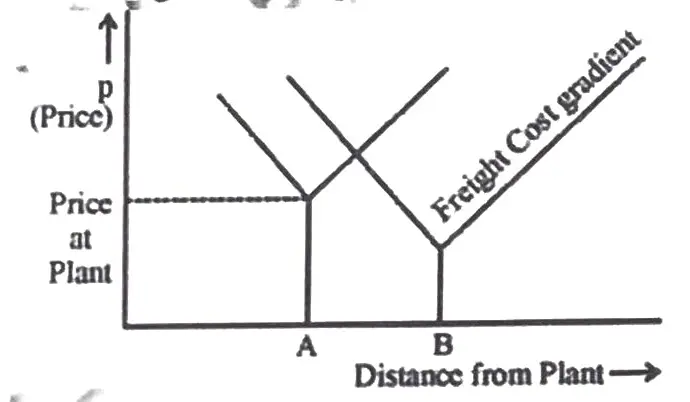
Which one of the following conditions of input price variables is applicable in the given diagram of the deviationn of a boundry between the market areas of two competing firms A and B, Where freight rate is equal ?
Show answer
Answer: option (1): AP> BP
Solution
Why is this the answer?
This is a diagram question, and the picture is in the 'see original' view. With equal freight rates, the boundary shifts toward the firm with the higher plant price, so A's price is greater than B's (AP > BP).
What about each option?
Right: option (1), as keyed.
Not keyed.
Not keyed.
Not keyed.
How do I remember it?
💡 Read the axes first, then find the point the question names.
#43 · NTA UGC-NET/JRF · Jan.2017
The nature of input cost-curve over space in industrial landscape becomes
Show answer
Answer: option (4): 'U' Shaped
Solution
Why is this the answer?
Over space, input cost is lowest at an optimum and rises either way. That gives a U-shaped (or V-shaped) space cost curve.
What about each option?
Not keyed.
Not keyed.
Not linear.
Right: U-shaped.
How do I remember it?
💡 Smith's space cost curve is U-shaped; the space revenue curve is an inverted U.
Question source: NTA UGC-NET/JRF and state Assistant Professor exam papers. The flip cards and notes here are written afresh.