Exactly as the exam asked them. Choose an option: you will see at once if it is right, and the small facts behind the question.
Take your time. Answer, see why, and reattempt any question as often as you like.
10 questions · 7 minutes · 40 seconds a question. Once you move on, you can’t come back, and answers show only at the end. Just like the real hall.
Whole test0:00
This question40
#37 · NTA UGC-NET/JRF · Dec.2020
What is not true about International trade in post - globalization phase ?
Show answer
Answer: option (3): Regional comparative advantage is on decline.
Solution
Why is this the answer?
Globalisation has not made regional comparative advantage decline; it still shapes what each region trades. The other three statements are true.
What about each option?
True
True
Right: not true
True
How do I remember it?
💡 Global markets still reward local strengths.
#38 · NTA UGC-NET/JRF · Dec.2020
There are three well - definedphases in International trade. The second phase, which is market with mobility of factors of production , remained in focus during
Show answer
Answer: option (3): 1970s and 1990s
Solution
Why is this the answer?
The second phase of international trade, marked by mobile capital, labour and firms (multinationals), ran from the 1970s to the 1990s.
What about each option?
First phase
Not the keyed span
Right: 1970s to 1990s
Third phase, digital globalisation
How do I remember it?
💡 Mobile factors: the age of the multinational.
#39 · NTA UGC-NET/JRF · Dec.2020
Assertion (A) : The globalization of production is concomitant to the globalization of trade, an one can't function without the other.
Reason (R) : The scale, volume and efficiency of international trade have all continued to increase since the 1970s due to ongoing process of global space\ time convergence.
Show answer
Answer: option (1): Both (A) and (R) are true and (R) is correc explanation of (A)
Solution
Why is this the answer?
Global production and global trade go together, and cheaper, faster transport and communication (space-time convergence) have grown both since the 1970s. R explains A.
What about each option?
Right: both true, R explains A
R does explain A
R is also true
A is also true
How do I remember it?
💡 Shrinking distance stretches the factory across the world.
#40 · NTA UGC-NET/JRF · Dec.2019
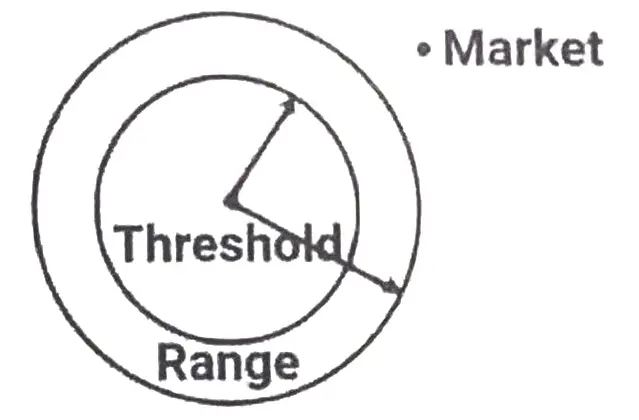
Above given figure explains a particular model, choose the correct option from the given below.
Show answer
Answer: option (2): Central place modal
Solution
Why is this the answer?
The figure in the original shows nested hexagonal market areas around centres of different order: Christaller's central place model.
What about each option?
A triangle of raw materials and market
Right: central place model
Rings of farm land
Lines of flow between two places
How do I remember it?
💡 Hexagons = Christaller.
#42 · NTA UGC-NET/JRF · Dec.2019
Lumbering falls in the category of :
Show answer
Answer: option (3): Primary activities
Solution
Why is this the answer?
Lumbering takes wood straight from forests, so it is a primary activity.
What about each option?
Services
Making goods
Right: primary
Knowledge work
How do I remember it?
💡 Cut = primary; carve = secondary.
#43 · NTA UGC-NET/JRF · June.2019
Which one of the following is an example of Quaternaries activities ?
Show answer
Answer: option (3): Retail and wholesale trade
Solution
Why is this the answer?
The key gives retail and wholesale trade. In most textbooks trade is tertiary and quaternary means knowledge work such as research and information services, so the key is loose here.
What about each option?
Secondary
Primary
Right: as keyed
Secondary
How do I remember it?
💡 Usually: trade is tertiary, research is quaternary.
#44 · NTA UGC-NET/JRF · Dec.2018
Which of the following can be categorized as a primary activity ?
Show answer
Answer: option (1): Coal mining
Solution
Why is this the answer?
Coal mining extracts a resource directly from the earth, so it is primary.
What about each option?
Right: coal mining
Tertiary
Secondary
Secondary
How do I remember it?
💡 Dig it up = primary.
#45 · NTA UGC-NET/JRF · Dec.2018
Assertion(A): The decade of 1990s witnessed urbanisation process speeding up economic growth in India.
Reason (R) : The urbanisation process resulted in a growing shortage of urban services and an overall deterioration in the quality-of-urban-life indices.
Show answer
Answer: option (2): Both (A) and (R) are true, (R) is NOT correct explanation of (A)
Solution
Why is this the answer?
In the 1990s urbanisation in India sped up economic growth, and it also caused shortages of urban services and poorer quality of life. Both are true, but the second does not explain the first.
What about each option?
R does not explain A
Right: both true, R not the explanation
R is also true
A is also true
How do I remember it?
💡 Growth and strain came together, not one from the other.
#46 · NTA UGC-NET/JRF · July.2018
List-I List-II
List-I
List-II
I
Subsitence Economy
A
Market compitition as primary force shaping the product patterns
II
Commercial Economy
B
Self-sufficiency, Low productiion and law population density
III
Intensive subsistence Economy
C
Self-sufficiency, high production andhigh population density
IV
Extensive Subistence economy
D
Little exchange of goods and only limited need formarkets
(a)
(b)
(c)
(d)
(1)
(ii)
(iii)
(i)
(iv)
(2)
(iv)
(i)
(iii)
(ii)
(3)
(iii)
(ii)
(iv)
(i)
(4)
(i)
(iv)
(iii)
(ii)
Show answer
Answer: option (2)
Solution
Why is this the answer?
A subsistence economy has little exchange (D, iv); a commercial economy is shaped by market competition (A, i); intensive subsistence means high output and dense population (C, iii); extensive subsistence means low output and sparse population (B, ii). Code (2): iv, i, iii, ii.
What about each option?
Wrong order
Right: iv, i, iii, ii
Wrong order
Wrong order
How do I remember it?
💡 Intensive = crowded and productive; extensive = sparse.
#47 · NTA UGC-NET/JRF · July.2018
Which one of the following factors most dominants in the localisation of high tech firms of silicon valley in California?
Show answer
Answer: option (4): Agglomeration economy
Solution
Why is this the answer?
Silicon Valley's firms cluster for agglomeration economies: shared talent, venture capital, Stanford's research and suppliers.
What about each option?
Labour is expensive there
Helps, but not dominant
Not dominant
Right: agglomeration economy
How do I remember it?
💡 Talent attracts talent.
Question source: NTA UGC-NET/JRF and state Assistant Professor exam papers. The flip cards and notes here are written afresh.