#74 · Assistant Professor paper · Madhya Pradesh assis.prof.2017
Which one of the following group is not correct -
Show answer
Answer: option (4): Urban field- R.H Northum
Solution
Why is this the answer?
The urban field was A. E. Smailes's term, not Northam's. Allix (umland), Dickinson (city region) and Green (hinterland) are correct.
What about each option?
Correct
Correct
Correct
Right: wrong, urban field is Smailes
How do I remember it?
💡 Northam = urbanisation S-curve, not urban field.
#75 · Assistant Professor paper · Madhya Pradesh assis.prof.2017
Who propounded Breaking Point Theory of urban influence?
Show answer
Answer: option (1): P.D converse
Solution
Why is this the answer?
P. D. Converse (1949) turned Reilly's law into the breaking-point formula: the point between two cities where their pull is equal.
What about each option?
Right: Converse
Reilly gave the original law
Carey worked on social physics
Not the author
How do I remember it?
💡 Converse found where the pull breaks.
#76 · Assistant Professor paper · Madhya Pradesh assis.prof.2017
Name of the scholar demarcating the population-resource regions of the world is
Show answer
Answer: option (3): Ackerman
Solution
Why is this the answer?
Edward Ackerman (1959) divided the world into population-resource regions, such as the US type, European type, Brazilian type, Egyptian type and Arctic-desert type.
What about each option?
Malthus did not map regions
Marx wrote on surplus population
Right: Ackerman
Zimmermann defined resources
How do I remember it?
💡 Ackerman: five types of people-resource balance.
#77 · Assistant Professor paper · Madhya Pradesh assis.prof.2017
In which respect cities primarily differ from villages?
Show answer
Answer: option (1): Functions
Solution
Why is this the answer?
Cities differ from villages mainly in function: villages do primary work like farming, cities do secondary and tertiary work like industry and services.
What about each option?
Right: functions
Both are found everywhere
Shapes overlap
A result of functions, not the main difference
How do I remember it?
💡 Village grows food, city makes and serves.
#78 · Assistant Professor paper · Madhya Pradesh assis.prof.2017
The concept of Primate City was given by
Show answer
Answer: option (1): Jefferson
Solution
Why is this the answer?
Mark Jefferson gave the concept of the primate city in 1939.
What about each option?
Right: Jefferson
Zipf gave rank-size
Mumford gave stages of city growth
Sjoberg wrote on the pre-industrial city
How do I remember it?
💡 Jefferson = primate.
#79 · Assistant Professor paper · Madhya Pradesh assis.prof.2017
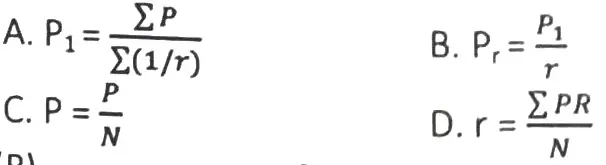
Which formula related to rank-size rule was propounded by G.K Zipf?
Show answer
Answer: option (2)
Solution
Why is this the answer?
The formulae are in an image in the original. Zipf's rule is Pn = P1 ÷ n (or P1 = n × Pn). The key gives option (2).
What about each option?
Not the keyed formula
Right: option (2)
Not the keyed formula
Not the keyed formula
How do I remember it?
💡 Nth city = biggest ÷ n.
#80 · Assistant Professor paper · Madhya Pradesh assis.prof.2017
Which Principle is not effective on functions, types and distribution of central places?
Show answer
Answer: option (3): Concentric zone principle
Solution
Why is this the answer?
Christaller's three principles are market (K = 3), transport (K = 4) and administrative (K = 7). Concentric zones belong to Burgess's city model.
What about each option?
One of his principles
One of his principles
Right: not a central place principle
One of his principles
How do I remember it?
💡 Christaller 3-4-7; Burgess rings.
#81 · Assistant Professor paper · Madhya Pradesh assis.prof.2017
What will be the pattern of a settlement located along a road?
Show answer
Answer: option (2): Linear Pattern
Solution
Why is this the answer?
Houses built along a road, river or canal form a linear (ribbon) pattern.
What about each option?
Roads meeting at a point
Right: linear
Streets spreading from a centre
Around a tank or hill
How do I remember it?
💡 One road, one line of houses.
#82 · Assistant Professor paper · Madhya Pradesh assis.prof.2017
Which principle applies in the case of K-7 hierarchy of central places, as per Christaller's Theory?
Show answer
Answer: option (4): Administration
Solution
Why is this the answer?
K = 7 is Christaller's administrative principle: each centre fully controls the six lower centres around it.
What about each option?
K = 3
K = 4
Not one of his principles
Right: administration
How do I remember it?
💡 Seven = one ruler, six subjects.
Question source: NTA UGC-NET/JRF and state Assistant Professor exam papers. The flip cards and notes here are written afresh.